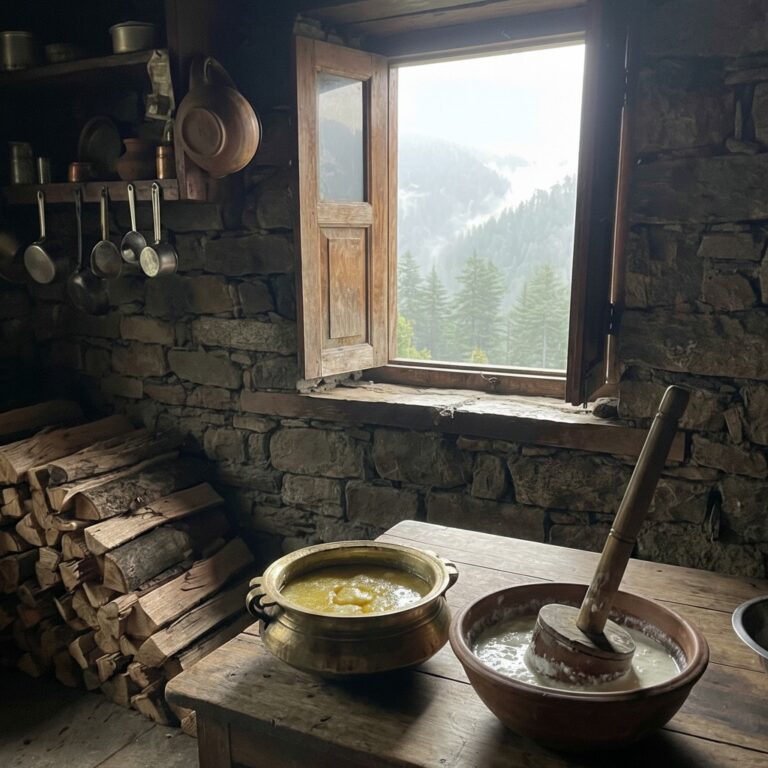
Pahadi ghee has always been an everyday essential in mountain households. It was valued not as a luxury, but as a dependable source of nourishment, warmth, and balance. Its importance comes not only from how it is used, but from how it is prepared and the kind of cows it comes from.
The Pahadi Cow Behind the Ghee
The foundation of pahadi ghee is the native Pahadi cow, commonly found across Himalayan regions such as Himachal Pradesh and Uttarakhand. These cows are indigenous hill cattle, adapted over generations to survive in steep terrain, cold weather, and variable conditions.
Pahadi cows are smaller in size and sure-footed, allowing them to graze freely on slopes and forest edges. Their diet consists mainly of wild grasses, native herbs, shrubs, and seasonal mountain vegetation, rather than commercial feed. This diverse grazing directly influences the quality of the milk and, eventually, the ghee.
Although pahadi cows produce less milk than commercial breeds, the milk is denser, richer in natural fats, and more suitable for traditional ghee preparation. Like most indigenous Indian cattle, they produce A2 milk, which has traditionally been considered easier to digest and better suited for regular consumption.
The butter derived from this milk is firm and aromatic, yielding ghee with a deeper yellow colour, often attributed to natural beta-carotene from grazing. Even small quantities of this ghee carry a distinct flavour, making it effective without heavy usage.
Preparation Guided by Belief and Discipline
In some mountain communities, ghee is not prepared on random days. A specific date is chosen under the guidance of the local deity, following village customs and traditional calendars. These dates are believed to be most suitable for preparing food that is meant to be pure and long-lasting.
On the chosen day, the process follows strict discipline. The curd is churned by hand, and the preparation is carried out in complete silence. Speaking is avoided to maintain calmness of mind and environment. The belief is that food absorbs the state in which it is prepared, and silence ensures purity of intention.
Before it is treated as food, the ghee is regarded as sacred. Only after the process is complete it is stored for household use. This reflects a mountain understanding that food should be made with patience, respect, and mental clarity.
Everyday Uses Beyond Cooking
In daily mountain life, pahadi ghee served multiple purposes. It was added to rotis, dal, rice, rajma-chawal, and simple meals to improve nourishment. Beyond cooking, it was also a trusted household remedy. It was commonly applied to chapped lips, used as warm nasal drops to relieve congestion, and given in small quantities for strength, especially during colder months.
Ghee was never measured scientifically. It was used according to season, age, and need—guided by experience rather than instructions.
Why Pahadi Ghee Is Still Relevant
Pahadi ghee is not a product of efficiency or scale. It is the result of:
- indigenous cows adapted to the mountains
- free grazing on diverse natural vegetation
- low-stress, small-scale rearing
- slow, disciplined preparation guided by belief
These factors together create ghee that is stable, aromatic, and deeply nourishing.
Even today, when prepared using these traditional methods, pahadi ghee reflects the values it comes from—restraint, respect for nature, and faith in doing things the right way rather than the fastest way.